
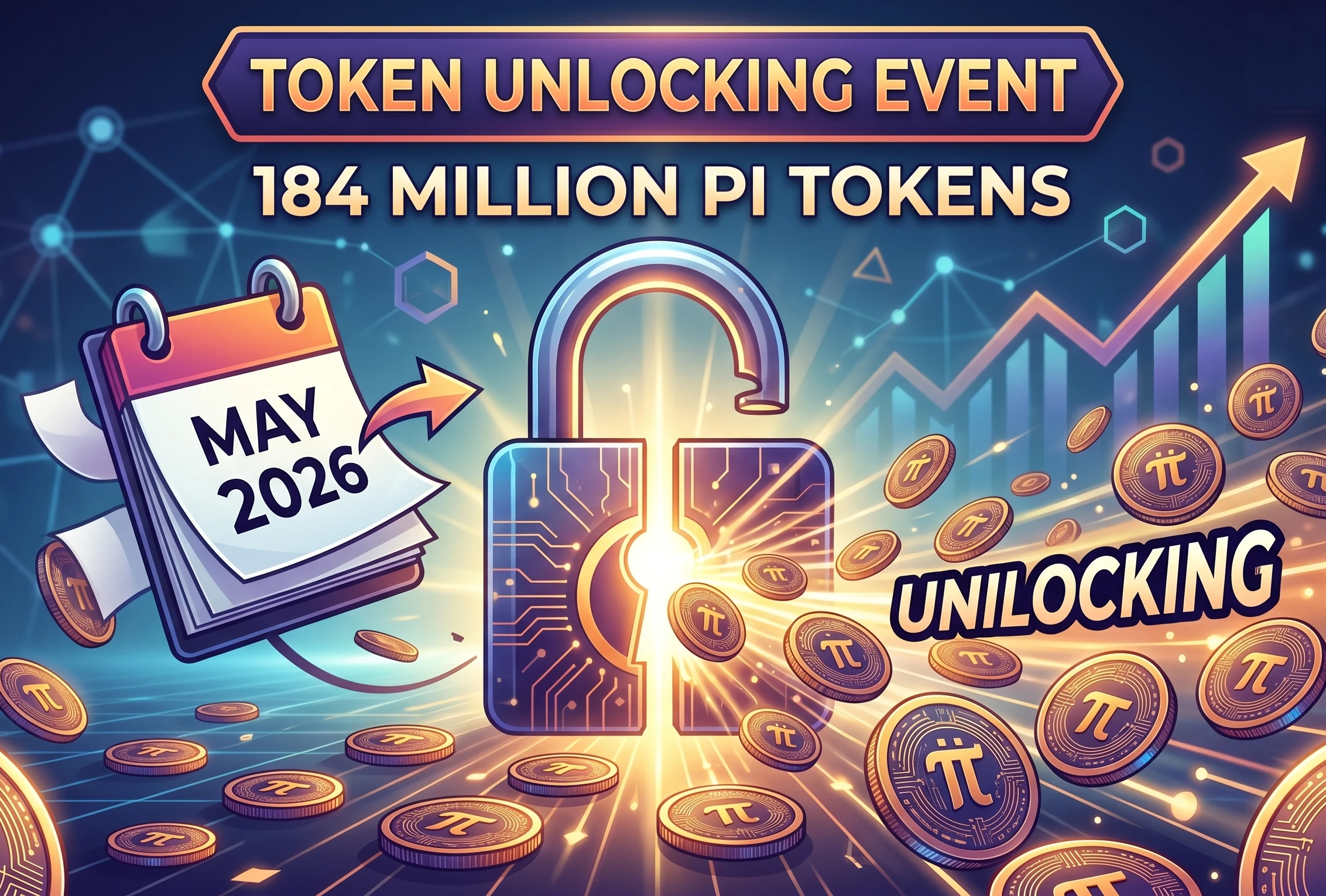
184 Million PI Tokens Unlocking in May 2026 — Will the Price Crash or Survive?
May 06, 2026 | Gudstory Org AI News
Thank you for reading this post, don't forget to subscribe!The cryptocurrency world is watching Pi Network closely this month as a massive token release event unfolds across May 2026. Approximately 184.5 million PI tokens are scheduled to enter circulation throughout the month — a development that has split the crypto community into two camps: those bracing for a sharp sell-off and those who believe the network’s growing ecosystem will cushion the blow.
At the time of writing, PI is trading around $0.18, significantly below its all-time high of $3.00 reached in February 2025 — just days after its mainnet launch. The token has already shed more than 90% from that peak, and many are now asking whether another large supply injection will push prices even lower, or whether strategic developments happening simultaneously could hold the line.
The Scale of the Unlock
Token unlocks are a standard mechanism in many blockchain projects. They refer to the scheduled release of previously restricted tokens — in Pi Network’s case, these include coins held by early miners, project contributors, and ecosystem reserve pools. Once unlocked, these tokens become freely tradeable and can be introduced to exchanges as sell pressure.
The May 2026 unlock does not happen all at once. According to on-chain data, the release is spread throughout the month at a pace of approximately 4.6 million tokens per day. Over 200 million tokens in total are expected to be released in May when the full schedule is accounted for, making it one of the heaviest unlock months on record for the project.
To put this in broader context, Pi Network has approximately 1.21 to 1.22 billion tokens scheduled to unlock across the entirety of 2026. With a maximum possible supply of 100 billion and a current circulating supply of around 10.3 billion, the long-term supply trajectory remains a significant consideration for anyone evaluating the token’s price potential.
The Bearish Case: Supply Flood Without Sufficient Demand
The concern among skeptics is straightforward. When a large number of previously locked tokens suddenly become available, holders who have been waiting for liquidity — including early miners who accumulated coins years before any exchange listing — may choose to sell immediately. This creates what analysts call a “supply overhang,” where the market must absorb more coins than buyers are prepared to purchase at current prices.
This has played out before in Pi’s own history. When the token listed on open mainnet in February 2025 and early participants finally gained the ability to trade, the price peaked and then collapsed dramatically. The pattern — unlock, surge of optimism, subsequent sell-off — has been observed repeatedly in the crypto industry, from Solana’s early vesting schedule to Aptos’s launch-day unlock events.
Adding to the bearish narrative is the fact that PI’s price has been range-bound and declining throughout most of April 2026, trading in a tight band that suggests weak buying demand and limited institutional interest. On-chain data shows that roughly 437 million PI tokens are currently sitting on centralized exchanges — a number that signals potential selling intent rather than long-term holding behavior.
The Bullish Case: Utility, Protocol Upgrades, and Conference Momentum
Despite the supply headwinds, Pi Network’s May calendar is packed with developments that supporters argue could offset the unlock pressure.
Protocol 23 Launch: The most significant technical milestone of the month is the scheduled launch of Protocol 23 on or around May 11, 2026. This upgrade introduces smart contract functionality to the Pi Network — a capability that has been missing since the project’s inception and one that is considered essential for competing with platforms like Ethereum, Solana, and Tron. Smart contracts enable the development of decentralized finance (DeFi) applications, real-world asset tokenization, and complex dApp ecosystems. If developers begin building on Pi following the upgrade, demand for PI tokens as transaction gas and utility fuel could meaningfully increase.
Consensus 2026 Presence: Pi Network is a Gold Sponsor at Consensus 2026, one of the most prominent events in the global blockchain calendar. Co-founder Dr. Chengdiao Fan is scheduled to deliver a keynote on May 6 titled “Aligning Web3, AI, and Blockchain for Utility,” while co-founder Nicolas Kokkalis is set to join a panel discussion on proof-of-personhood on May 7. This level of high-profile institutional exposure is broadly considered bullish, as it positions Pi alongside leading Web3 and AI narratives being discussed in 2026. The conference presence also attracted some early momentum — PI saw a 5% price jump on April 29 when the appearances were confirmed.
KYC and Network Scale: With 17.5 million users having completed identity verification and 15.7 million migrated to mainnet, Pi Network holds a level of real-world user adoption that most blockchain projects simply cannot claim. If even a fraction of these users begin actively transacting within the ecosystem, the demand side of the equation becomes more credible.
The Utility Equation: The Key Variable
Perhaps the most honest framework for thinking about this unlock is not “will the price crash?” but rather “will utility grow fast enough to absorb new supply?”
This is the tension at the heart of every major token unlock: supply is predictable and scheduled, while demand is uncertain and organic. If a significant portion of the newly available PI tokens flows into decentralized applications, commerce platforms, and on-chain services — rather than directly onto exchanges — price stability becomes achievable even with high supply growth.
The Pi App Studio, a generative AI-powered development tool, has already enabled over 51,800 pioneers to build decentralized applications. Pi Network Ventures, the project’s $100 million investment arm, has funded ventures in gaming (CiDi Games) and AI (OpenMind), with the goal of creating real-world transaction demand for the token. If Protocol 23 accelerates developer adoption and brings viable DeFi tools like PiSwap (a decentralized exchange) and PiVault (a staking mechanism) online, the supply-demand dynamic could shift considerably.
Market Psychology and What to Watch
Beyond fundamentals, market psychology plays an outsized role in how unlock events play out. If community members expect a crash, they may sell preemptively — creating a self-fulfilling prophecy. Conversely, strong narrative momentum around Protocol 23 and Consensus 2026 could encourage holding behavior and attract new buyers.
Key indicators to track in May 2026 include exchange net flows for PI (whether tokens are moving onto exchanges, signaling sell intent, or being withdrawn, signaling accumulation), the volume of new smart contract deployments after Protocol 23 goes live, and whether any additional tier-one exchanges announce PI listings during or following Consensus 2026. Binance and Coinbase have not yet listed the token, and any such announcement would likely outweigh unlock-driven selling pressure.
Verdict: Survival Is Possible, But Not Guaranteed
The 184 to 200 million PI tokens unlocking in May 2026 represent a genuine challenge for price stability. History suggests that supply events of this magnitude, without proportionate demand growth, produce downward pressure. Pi Network’s price has already experienced a brutal correction from its all-time high, and the token has limited room to absorb further sentiment shocks.
However, the May calendar is unusually rich with catalysts. Protocol 23 could transform Pi from a simple peer-to-peer payment network into a competitive smart contract platform almost overnight. The Consensus 2026 presence provides institutional credibility at a moment when the crypto market is hungry for credible AI-blockchain narratives. And the project’s unmatched user base — over 17 million verified participants — represents latent demand that no pure-speculative token can claim.
The answer to whether PI survives May likely depends on a single variable: whether the Protocol 23 launch generates credible developer activity quickly enough to signal that the supply entering the market has somewhere productive to go. If it does, May 2026 may be remembered as the month Pi Network turned a corner. If it does not, the unlock could deepen an already painful drawdown.
For investors, the message is the same as always: supply events create volatility, but ecosystems create value. In May 2026, Pi Network must demonstrate that it is building the latter faster than it is distributing the former.
This article is for informational purposes only and does not constitute financial or investment advice. Cryptocurrency markets are highly volatile. Always conduct your own research before making investment decisions.