
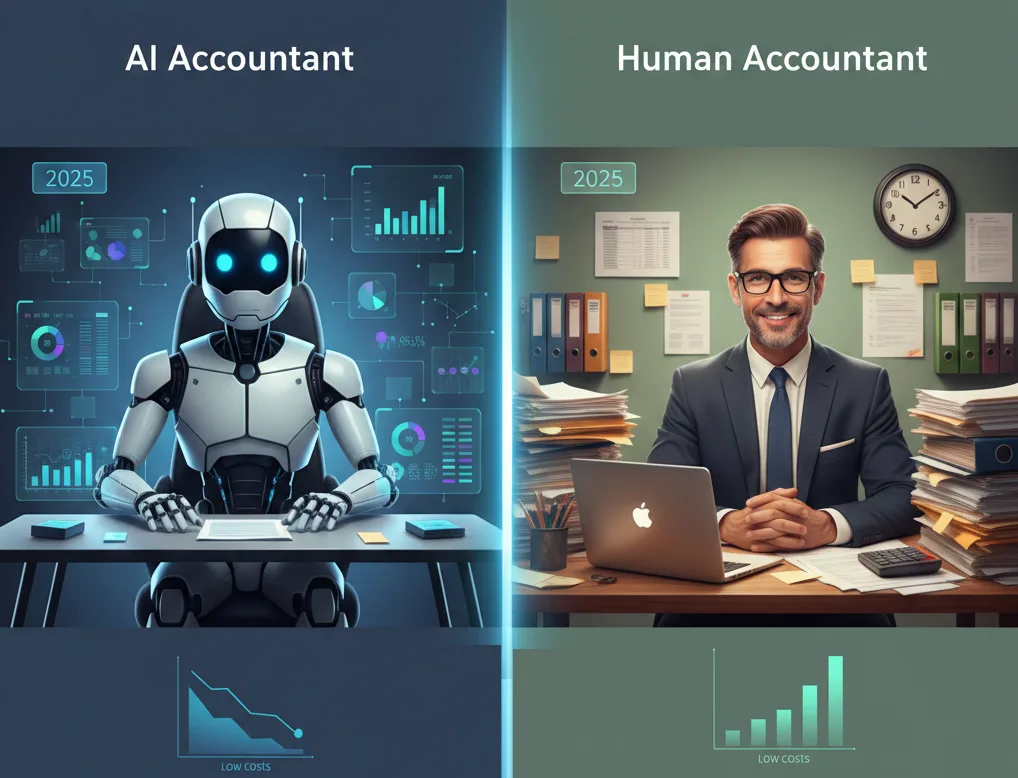
AI vs Human Accountant: Cost Comparison in 2025 – Which One Saves Your Business More Money?
December 17, 2025 | Gudstory Org AI News
Thank you for reading this post, don't forget to subscribe!The financial landscape is undergoing a seismic shift. As artificial intelligence continues its rapid advance into professional services, small business owners and finance leaders face a pressing question: Should I stick with a human accountant or embrace AI-powered accounting software? The stakes are higher than ever. According to recent industry data, AI usage in accounting has surged from nine percent in 2024 to 41 percent in 2025, representing a fourfold increase in just twelve months. Meanwhile, businesses using AI accounting tools report saving up to 30 percent on operational costs while cutting manual errors by 90 percent.
This comprehensive cost comparison cuts through the hype to deliver real numbers, practical insights, and data-driven guidance on choosing between AI vs human accounting solutions in 2025.

Understanding AI Accounting: How It Actually Works
AI accounting software represents far more than glorified calculators. These platforms leverage machine learning, optical character recognition, and natural language processing to automate financial tasks that traditionally required human intervention.
Modern AI accounting tools can extract data from invoices with 98 percent accuracy, automatically categorize thousands of transactions in minutes, match purchase orders with invoices in real time, and flag anomalies that might indicate fraud or errors. The technology operates continuously without breaks, processing vast amounts of structured data with consistency that humans simply cannot match.
Unlike traditional accounting software that merely stores and organizes data, AI systems learn from patterns, predict future needs, and adapt to your business over time. They handle routine bookkeeping, generate financial reports, reconcile bank statements, process expense claims, and even prepare preliminary tax documents autonomously.
The Real Cost of AI Accounting Software in 2025
AI accounting software pricing follows a tiered structure based on business size, transaction volume, and feature requirements. The cost breakdown reveals significant variation across market segments.
Small Business and Freelancer Options
For solopreneurs and freelancers, entry-level solutions start remarkably affordable. Wave and Zoho Books offer free plans for businesses generating under $50,000 in annual revenue. Mid-tier platforms like QuickBooks and Xero range from $15 to $80 monthly, providing robust automation for growing businesses.
Bookeeping.ai caters specifically to freelancers at $29 per month with conversational AI features. Botkeeper starts at $69 monthly per license, combining machine learning with human oversight for professional financial management.
Mid-Market Solutions
Small to medium-sized businesses with moderate accounting needs typically invest between $50 and $200 per user monthly for platforms offering inventory management, payroll processing, and project accounting capabilities. Sage Intacct requires custom pricing but delivers advanced features and compliance tools essential for scaling operations.
Integra Balance AI offers two pricing tiers: Balance AI at $55 per client monthly and Balance Pro at $5 per client monthly, with additional AI OCR processing costing $10 per client monthly. Notably, these solutions cost just 20 to 33 percent of a full-time employee’s salary.
Enterprise Platforms
Large enterprises requiring comprehensive ERP integration turn to NetSuite, SAP, and similar platforms starting around $500 monthly and scaling based on users, modules, and implementation scope. Trullion pricing begins at $3,000 annually for AI-powered lease accounting and revenue recognition focused on regulatory compliance.
Custom enterprise implementations typically involve one-time setup fees ranging from several thousand to tens of thousands of dollars, plus annual licensing costs that scale with organizational complexity.
Hidden Costs to Consider
Beyond subscription fees, businesses should budget for data migration from legacy systems, which can cost $2,000 to $10,000 depending on complexity. Staff training typically requires 10 to 40 hours per employee, representing indirect costs in lost productivity during the learning curve.
Integration with existing business systems may require additional API connections or middleware, potentially adding $500 to $5,000 annually. Ongoing support and maintenance packages often cost 15 to 20 percent of the annual licensing fee.
The True Cost of Hiring Human Accountants
Human accountant fees vary dramatically based on credentials, experience, geographic location, and service complexity. Understanding the pricing landscape helps businesses budget accurately for professional financial expertise.
Freelance and Contract Accountants
Freelance accountants and bookkeepers charge hourly rates ranging from $40 to $100 for entry-level professionals handling basic bookkeeping tasks. Mid-level accountants with several years of experience typically command $100 to $200 hourly.
Platforms like Upwork report average CPA rates between $12 and $52 per hour, suggesting freelance professionals often charge less than traditional firms while maintaining competitive quality.
Certified Public Accountants (CPAs)
CPAs represent the premium tier of accounting services, with hourly rates spanning $150 to $400 for standard services. Experienced CPAs in major metropolitan areas like New York, Los Angeles, San Francisco, and Boston frequently charge $300 to $500 hourly, while rural practitioners may charge $150 to $250.
Forensic accountants specializing in litigation support and fraud investigation command even higher rates, typically $300 to $500 hourly due to their specialized expertise.
Project-Based and Flat Fee Services
Many accountants offer fixed-fee structures for predictable services. Tax preparation costs vary by complexity: simple Form 1040 returns with standard deductions average $200 to $300, moderately complex returns with itemized deductions cost $400 to $600, and complex returns involving self-employment income or rental properties range from $800 to $1,500.
Small business tax returns typically cost $500 to $2,000 annually depending on entity structure and financial complexity. Form 1040 with Schedule C averages approximately $457 nationally.
In-House Accountant Salaries
Businesses requiring full-time accounting support face substantial salary commitments. Entry-level accountants in the five largest U.S. cities earn between $45,000 and $65,000 annually. Mid-level accountants with CPA certification command $70,000 to $100,000, while senior accountants and controllers earn $90,000 to $150,000 or more.
These figures exclude employer-paid benefits, payroll taxes, office space, equipment, and continuing education costs, which typically add 20 to 30 percent to base compensation.
Monthly Retainer Arrangements
Fixed monthly retainers provide budget predictability for ongoing services. Basic bookkeeping and monthly financial statement preparation typically costs $500 to $1,000 monthly. Comprehensive services including bookkeeping, financial reporting, and tax planning range from $1,500 to $3,000 monthly.
Full-service packages with strategic advisory support command $2,500 to $5,000 monthly or more, depending on business complexity and advisor experience level.
Side-by-Side Cost Comparison: AI vs Human Accountant
| Service Type | AI Accounting Software | Human Accountant |
|---|---|---|
| Basic Bookkeeping | $0-$80/month | $500-$1,000/month |
| Transaction Processing | Unlimited (within plan) | $40-$100/hour |
| Financial Reports | Automated, real-time | $150-$400/hour |
| Tax Preparation (Simple) | $0-$50 (add-on) | $200-$300 |
| Tax Preparation (Complex) | Limited capability | $800-$1,500 |
| Annual Cost (Small Business) | $360-$2,400 | $6,000-$36,000 |
| Setup/Onboarding | $0-$5,000 | $500-$2,000 |
| Scalability Cost | Minimal (per-user fees) | Linear (more hours/staff) |
| Advisory Services | Limited/None | $150-$500/hour |
The cost differential becomes stark when analyzing annual expenditures. A small business using mid-tier AI accounting software at $80 monthly spends $960 annually, while comparable human bookkeeping services at $750 monthly total $9,000 annually—a difference exceeding $8,000.
However, this comparison oversimplifies the value equation, as human accountants provide strategic guidance, regulatory interpretation, and relationship-based insights that current AI cannot replicate.
Accuracy, Scalability, and Compliance Comparison
Accuracy Metrics
AI accounting software demonstrates impressive accuracy in structured data processing. Optical character recognition technology achieves 98 percent accuracy in extracting data from invoices and receipts. Automated transaction categorization reduces manual errors by up to 90 percent compared to human data entry.
A Stanford University study found that accounting firms using AI saw a 12 percent increase in reporting granularity, maintaining more detailed financial records without sacrificing accuracy. However, 62 percent of accountants surveyed expressed concerns about errors and accuracy in AI-generated reporting, particularly for uncertain transactions.
Human accountants scored 18 out of 20 on a standardized debits and credits test, while ChatGPT achieved similar results. Yet human accountants excel dramatically in qualitative analysis, contextual interpretation, and judgment calls that AI cannot replicate.
One critical finding: when AI suggests diverging categories for uncertain transactions, accountants often follow AI recommendations even when confidence scores are low, potentially introducing errors attributable to algorithmic limitations.
Scalability Advantages
AI accounting platforms scale nearly effortlessly. Adding users typically costs $10 to $50 per additional seat monthly. Processing volume expansion requires no marginal cost within subscription tiers, enabling businesses to handle transaction growth from hundreds to thousands monthly without proportional cost increases.
Human accounting services scale linearly. Doubling transaction volume generally requires doubling billable hours or hiring additional staff. Small firms handling 500 transactions monthly can easily absorb growth to 750 transactions with existing AI systems, while human accountants would require 50 percent more hours to maintain service quality.
Compliance and Regulatory Considerations
Tax law and accounting regulation complexity presents challenges for both AI and human solutions. AI systems excel at applying consistent rules across thousands of transactions, automatically updating for standard regulatory changes through software patches.
However, AI struggles with nuanced regulatory exceptions, ambiguous guidance, and jurisdictional variations that require professional judgment. Human CPAs provide interpretive guidance for complex tax positions, represent clients during IRS audits, and offer liability protection through errors and omissions insurance.
Regulatory compliance services like ASC 842 lease accounting and ASC 606 revenue recognition require specialized AI tools designed specifically for these standards. General-purpose AI accounting platforms may lack the sophistication necessary for specialized compliance requirements.
Advantages and Disadvantages: AI Accountants
Key Advantages
Cost Efficiency: AI accounting software costs 70 to 90 percent less than equivalent human services for routine tasks. A business spending $12,000 annually on bookkeeping services can reduce costs to $1,000 to $2,000 with AI automation.
Speed and Availability: AI operates continuously, processing transactions in real time rather than waiting for monthly close procedures. Bank reconciliations that take human accountants hours complete in minutes, enabling faster month-end closes and more timely financial insights.
Consistency and Accuracy: AI eliminates variability in transaction classification, applies accounting rules uniformly across all entries, and reduces keystroke errors inherent in manual data entry. Pattern recognition capabilities identify anomalies and potential fraud faster than manual review.
Scalability: Growing from 100 to 10,000 monthly transactions requires minimal incremental investment with AI platforms. Businesses can expand operations without proportionally expanding accounting budgets.
Significant Limitations
Limited Contextual Understanding: AI struggles to interpret transactions within broader business context. Unusual one-time expenses, relationship-driven accounting decisions, and industry-specific nuances require human interpretation that current AI cannot provide.
Lack of Strategic Advisory: AI generates reports but cannot advise on growth strategies, financing options, operational improvements, or long-term planning. Strategic value creation remains firmly in human domain.
Compliance Uncertainty: Complex tax positions, audit representation, and regulatory interpretation require licensed professionals. AI cannot provide the legal protection and accountability that CPAs offer.
Technology Dependence: System outages, software bugs, and integration failures can disrupt financial operations. Businesses become dependent on vendor reliability and technical support quality.
Advantages and Disadvantages: Human Accountants
Compelling Advantages
Professional Judgment: Human accountants interpret ambiguous situations, apply ethical reasoning, and exercise discretion that AI cannot replicate. Complex accounting decisions require contextual understanding that extends beyond rule-based processing.
Strategic Advisory: Experienced accountants provide proactive recommendations for tax optimization, cash flow management, financing strategies, and business growth planning. This consultative value often justifies the higher cost through improved business outcomes.
Relationship and Trust: Client relationships built on trust, confidentiality, and personal understanding create value beyond transaction processing. Human accountants become trusted advisors who understand business goals and challenges intimately.
Regulatory Expertise: CPAs navigate complex tax codes, represent clients before regulatory agencies, and provide audit protection through professional liability insurance. This expertise becomes invaluable during audits, disputes, or complex compliance situations.
Adaptability: Human accountants quickly adapt to unique business circumstances, interpret new regulations, and apply creative problem-solving to unprecedented situations. This flexibility proves essential in rapidly changing business environments.
Notable Disadvantages
Higher Costs: Human accounting services cost 5 to 20 times more than AI alternatives for routine tasks. Small businesses operating on tight margins may struggle to afford comprehensive professional services.
Limited Availability: Accountants work standard business hours, take vacations, and handle finite client loads. Businesses requiring immediate financial information outside business hours may face delays.
Potential for Human Error: Manual data entry introduces keystroke errors, fatigue affects accuracy during tax season, and oversight mistakes can occur under time pressure. Even experienced professionals occasionally make mistakes.
Scalability Challenges: Growing businesses must hire additional accountants or accept service degradation as transaction volumes increase. Finding, training, and retaining quality accounting staff presents ongoing challenges.
Best Choice for Different Business Types
Startups and Solopreneurs
Early-stage startups with limited budgets and straightforward financial situations benefit most from AI accounting software. Monthly costs under $100 provide professional bookkeeping capabilities without stretching minimal resources.
Recommended approach: Use AI platforms like QuickBooks, Xero, or Wave for daily bookkeeping and transaction processing. Engage a CPA on project basis for annual tax preparation and strategic tax planning, typically costing $500 to $1,500 annually.
This hybrid model delivers 80 percent cost savings on routine tasks while preserving access to professional expertise for critical decisions.
Small to Medium Enterprises (SMEs)
Growing businesses with 5 to 50 employees benefit from combining AI automation with fractional CFO or controller services. AI handles transaction processing, reconciliations, and report generation, while human professionals provide monthly financial review, strategic planning, and compliance oversight.
Recommended approach: Invest in mid-tier AI accounting software ($100 to $300 monthly) plus monthly retainer with experienced accountant ($1,000 to $2,500 monthly). This hybrid approach costs significantly less than full-time accounting staff while providing professional oversight.
E-commerce and High-Volume Businesses
Online retailers processing thousands of transactions monthly across multiple sales channels require specialized AI solutions. Platforms like Link My Books automate complex transaction processing, VAT calculations, and multi-jurisdiction sales tax compliance.
Recommended approach: Deploy industry-specific AI accounting platforms with deep marketplace integrations. Supplement with quarterly reviews by e-commerce accounting specialists who understand platform-specific challenges and optimization opportunities.
Large Enterprises
Corporations with complex organizational structures, multiple entities, international operations, and stringent reporting requirements need enterprise-grade solutions combining advanced AI with dedicated accounting teams.
Recommended approach: Implement comprehensive ERP platforms like NetSuite or SAP with embedded AI capabilities. Maintain in-house accounting departments supplemented by Big Four or national firm relationships for audit, tax, and strategic advisory services.
Large enterprises should view AI as augmentation technology empowering existing teams rather than replacement strategy.
Real-World Business Use Cases and 2025 Trends
Small Business Success Story
A boutique marketing agency with eight employees previously spent $1,200 monthly on bookkeeping services and an additional $2,500 annually on tax preparation. After implementing QuickBooks with AI-powered features at $80 monthly, they reduced bookkeeping costs by 93 percent.
They maintained a quarterly CPA relationship at $500 per quarter for strategic tax planning and compliance review. Total annual accounting costs dropped from $16,900 to $3,460—an 80 percent reduction—while improving financial reporting timeliness.
Professional Services Firm Transformation
A 15-person accounting firm serving 200 small business clients adopted Integra Balance AI to automate routine bookkeeping tasks. The platform processed data entry, month-end procedures, and transaction management autonomously, with built-in human review processes.
The firm reduced time spent on routine processing by 40 percent, enabling accountants to take on 30 additional clients without hiring new staff. Partner compensation increased 25 percent while client fees remained competitive. The firm positioned itself as a forward-thinking advisory practice rather than traditional compliance shop.
Enterprise Implementation Results
A mid-market manufacturing company with $50 million in annual revenue implemented NetSuite with embedded AI capabilities. The system automated invoice processing, expense management, financial anomaly detection, and report generation.
Finance team productivity increased 35 percent, month-end close time decreased from 12 days to 7.5 days, and reporting granularity improved 12 percent. The company redirected accounting staff toward FP&A and strategic analysis rather than transaction processing, creating measurable business value exceeding implementation costs within 14 months.
Industry Adoption Statistics
Current data reveals aggressive AI adoption across the accounting profession. AI usage jumped from 9 percent to 41 percent of firms in just one year, with 72 percent of AI-adopting firms using the technology weekly and 35 percent using it daily.
Investment follows adoption trends, with 77 percent of firms planning to increase AI investments over the next three years. Among large firms, 40 percent target double-digit growth in AI spending, signaling confidence in technology’s value proposition.
Perhaps most tellingly, 73 percent of regular AI users report better-than-expected results, particularly in client service quality, financial insights accuracy, and operational efficiency. Advisory services have become nearly universal, with 93 percent of firms offering them—up from 83 percent in 2024.
The global AI accounting market reflects this enthusiasm, projected to grow from $6.68 billion in 2025 to $37.6 billion by 2030, representing a remarkable 47 percent compound annual growth rate.
Regional Adoption Variations
North America leads AI accounting adoption, accounting for 38.76 percent of global revenue due to mature business environments, high digital literacy, and widespread cloud infrastructure. The United States benefits particularly from stringent regulatory frameworks like GAAP and Sarbanes-Oxley that drive demand for sophisticated compliance tools.
Asia-Pacific exhibits the fastest regional growth at 47.9 percent CAGR, more than 10 percentage points above any other region. India stands out dramatically, with 73 percent of businesses planning AI deployment in accounting workflows by 2025, eclipsing the global average of 52 percent.
Final Verdict: When AI Wins and When Humans Remain Essential
The AI versus human accountant debate represents a false dichotomy. The most effective approach for most businesses combines AI automation for routine tasks with human expertise for strategic guidance and complex decision-making.
AI Wins When:
- Processing high-volume routine transactions (data entry, categorization, reconciliation)
- Generating standard financial reports with consistent formatting
- Monitoring transactions for anomalies and potential fraud
- Handling straightforward bookkeeping for small businesses
- Providing real-time financial dashboards and key metrics
- Maintaining 24/7 availability for transaction processing
- Scaling operations without proportional cost increases
Human Accountants Win When:
- Interpreting complex tax regulations and ambiguous guidance
- Providing strategic advisory for business growth and financing
- Representing clients during IRS audits or regulatory disputes
- Making nuanced accounting judgments requiring contextual understanding
- Building trusted advisor relationships with business owners
- Navigating unprecedented situations requiring creative problem-solving
- Offering professional liability protection through E&O insurance
- Explaining financial implications of strategic decisions to non-financial stakeholders
The Optimal 2025 Strategy
Forward-thinking businesses embrace a hybrid model that leverages each approach’s strengths. Small businesses and startups should deploy AI accounting platforms for daily bookkeeping while maintaining project-based or quarterly relationships with CPAs for tax planning and strategic guidance.
Growing SMEs benefit from combining mid-tier AI solutions with fractional CFO services, achieving professional financial management at a fraction of full-time staffing costs. Large enterprises should implement enterprise AI platforms that augment existing accounting teams rather than replacing them.
The accounting profession itself recognizes this future. Industry research shows that 85 percent of accounting professionals are excited or intrigued by AI, yet only 37 percent of firms invest in AI training. Firms that do invest unlock an additional seven weeks of capacity per employee per year—a compelling productivity gain.
As one industry leader observed, “AI will not disrupt the accounting profession, but it will change what an accountant does.” The accountants who thrive in coming years will be those who master AI tools to handle routine work efficiently while focusing their expertise on high-value advisory services that AI cannot replicate.
The question for 2025 is not whether to choose AI or human accountants—it’s how to combine both strategically for maximum business value at optimal cost. Businesses that make this transition thoughtfully will enjoy the best of both worlds: the efficiency and affordability of AI combined with the strategic insight and professional judgment that only experienced human accountants provide.